Thank you for coming to talk about teaching structure with me today.
The printables described are linked below.
Category: Uncategorized
Exponent Operation
I made this little operation application a few years ago in Seattle. It was fun, and I used it every year for practicing exponent rules, but I never ended up building other stuff for other units. It would be very easy to do so.
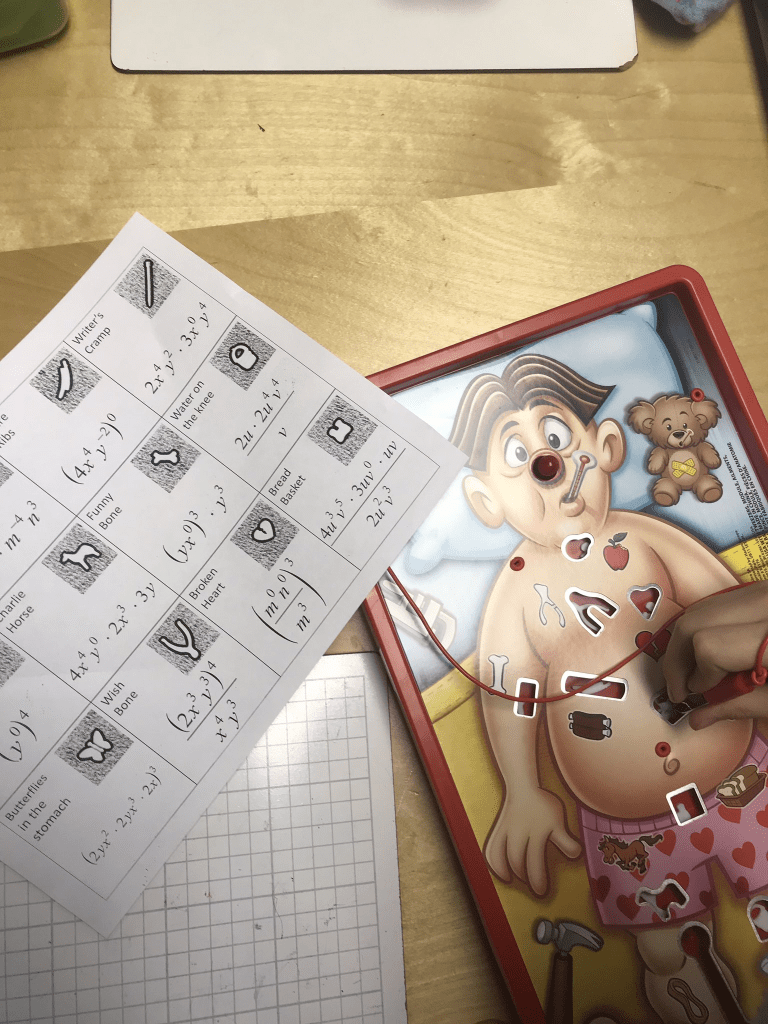
WARNING: this game requires the game operation, which has lots of little pieces, and batteries. This game is fun, but not something that I think scales very well to a class of more than 12 or 15 kids.
Anyway, you group kids, and have them take turns playing the game operation. If they successfully remove a piece from the board, the OTHER students must solve the corresponding problem from the sheet below.
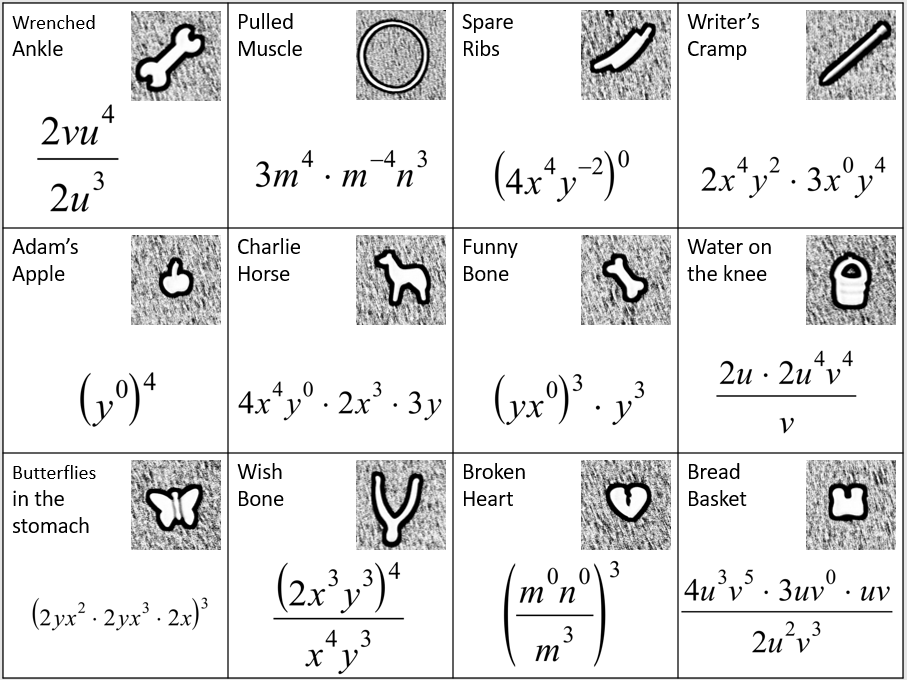
I tried to attach the harder problems to the harder pieces from the gameboard to remove. There is also an answer key in the documents below that I printed out in a different color so kids could check their work.
Scrub up! It’s surgery time!
Fear the Factor
I wanted to share my favorite classroom game for those days at the end of the semester where you need to fill some time with some lite math. (It’s my 5×5) It’s one that I stole from my old camp buddy Garrett Mandeville. He’s a sweetie, and he shared this game with me my first year teaching. It’s a simple one to run, and the kids that I have played it with at every level have LOVED it. It didn’t have a name when he gave it to me, but I slapped a 2001 TV reference on it, and posted it here for internet points.
The setup is pretty simple. You think of a number, and write it on a post-it that goes in your pocket. The kids get a handout. All that’s on it is a 1-100 grid. I generally print them four on a page so you can play a few rounds.
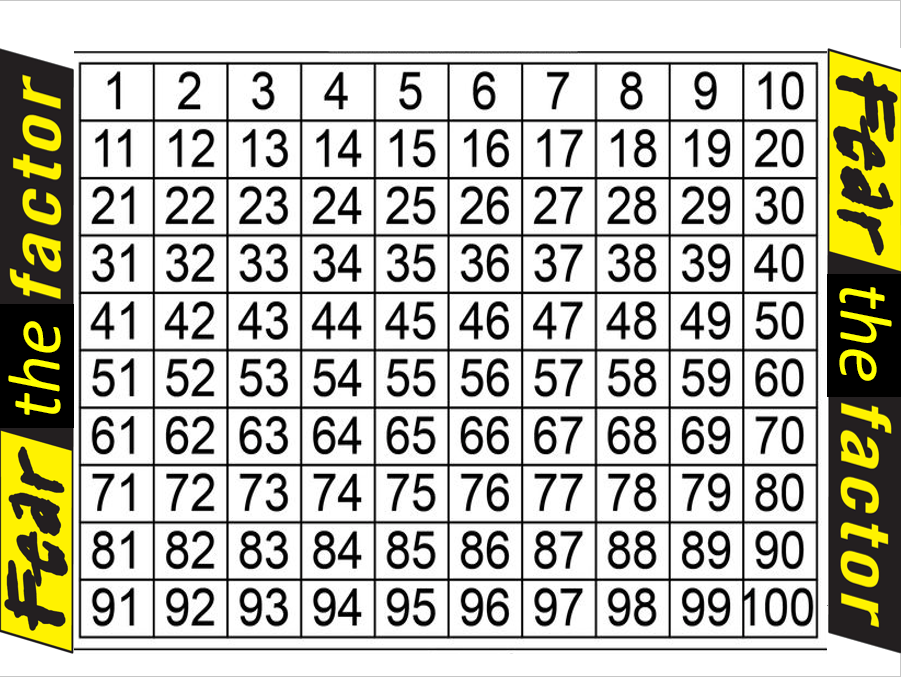
Students are in groups of 4, and their task is to guess your number. BUT they get some help from factors. Each team gets a turn and their turn goes like this:
1: They get to ask about one factor. (example: Is 5 a factor of your number?)
2: They get one guess (example: Is 37 your number?)
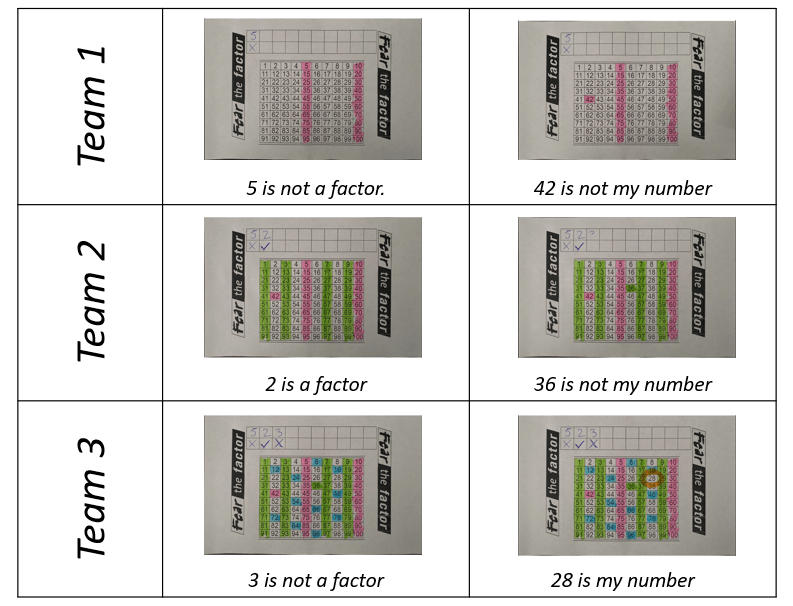
If they guess the number, they win! If not, it moves on to the next team. The first round, I play along on the whiteboard, crossing off the numbers that are eliminated with each factor and with each guess. Subsequent rounds, I only answer questions, and they are in charge of filling their boards, and tracking the answers that I give to each of the groups. This makes it so that every student plays along during each team’s turn. Below is what a student board might look like as they follow along with the guesses from each team.
A few notes:
- It is good to pick a number with a few factors to make the game more interesting (32, 48, 90, 45, 42 etc.)
- Each round lasts about 5 groups.
- I usually have starbursts on hand as prizes. (If you don’t want the kids begging for a pink ones, I have a workaround for that that I stole from my old friend Laura. I usually grab one at random. Each winner can either take the hidden candy as is, or guess the color. A successful guess means that they win one of each color, and an unsuccessful guess they get nothing)
- I keep a stack of these grids on hand as an emergency lesson. If the internet craps out during a Desmos lesson or if something else unexpected happens, this can fill 30 minutes with kids of every level, and it’s a snap to setup.
- Printables and ppt below!
Telephone
This collaborative math routine is based on the game “telephone.” Telephone, like that game where you whisper a word to the person next to you, and it goes around in a circle until it gets back to you. This routine works much the same way, but it uses math.
The rules are pretty simple. Print out strips of paper so that each kid in the group has a unique problem. For example, I used this strip for graphing last semester with my 8th graders.
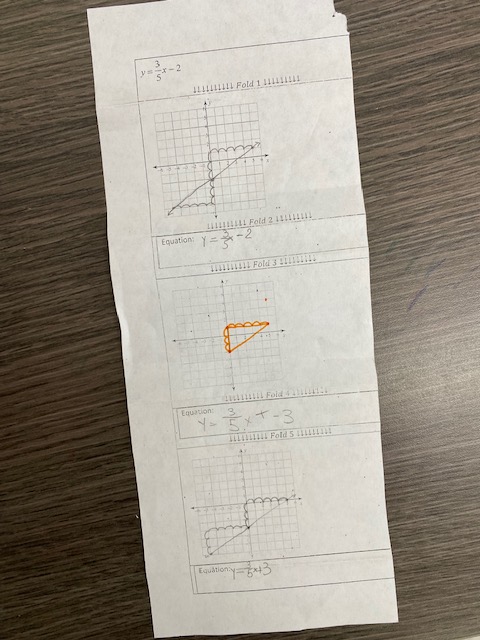
Each student graphs the equation on their strip of paper. When everybody in the group is ready, everybody folds their strip along the first line (so that the equation is hidden) and passes the strip of paper to the next student. Now every student has a piece of paper with a line graphed on it, and they must turn that line back into an equation.
Fold, pass, graph. Fold, pass, equation. Fold, pass, graph. etc.
At the end, have the kids unfold their strips of paper, and if their group ALL did their part correctly, the equation at the bottom should match the equation at the top. Below is a “before” and an “after” from a linear inequalities set:
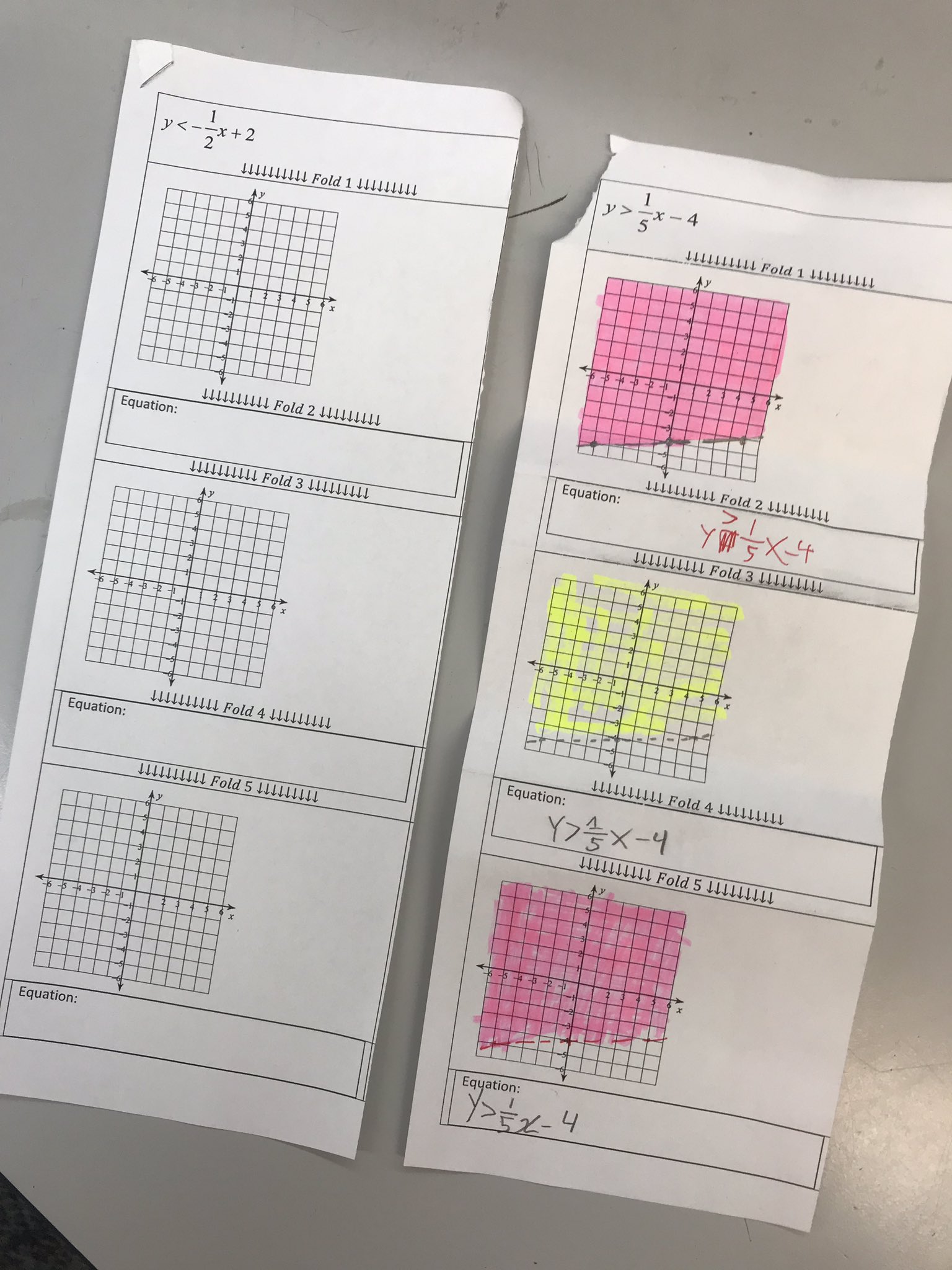
It’s a great routine that works with any math skill that works forwards AND backwards. The ones that I have used with my classes are linked below.
They are word docs (so that they are editable) but printing to PDF first will help them print better. Hope you dig it!
Greed
I don’t even know where this game came from. I looked up greed dice games online, and this is not what popped up, so bear with me. This game is a great little strategy/luck game, and all you need is a couple of dice.
The rules are pretty simple.
-One player rolls both dice. If you are in the game, you get the points on the dice. 5 and a 2 is worth seven points. First to 100 wins. (Or, you can play to 200 for a longer game.)
-Doubles are worth double. For example: double fours are worth 16.
-BUT BE CAREFUL. If either dice comes up with a “1,” all standing players lose whatever points that they have earned that round.
-This is why the game is called greed. If the first three rolls are “5/2” and then “4/4” and then “3/6,” any players standing up have earned 7, 16 and 9 points for a total of 32 points. At any point, a player can leave the game to protect the points that they have earned. A “greedy” player will stay stay in the game longer, and risk their points against the dice.
-Once you decide to leave the game, you get to keep the points that you have earned, BUT you can’t earn any more points until a “1” is rolled and a new player starts rolling the dice. You are safe, but you might miss out on points.
-(One last rule: Double Ones on the dice cause all standing players to lose ALL points earned over all rounds. It is a fun hail-mary rule that can totally change the game)
I learned this game from a roommate in Seattle, and I have returned to it often. It’s a quick travel game, and it works with 2 players all the way up to a class full of kids.
With a class, I like to have the kids track their own scores and they show that they are in the game by standing up. (They sit to show that they are out of the game). It’s a fun little game if you find yourself with 20 minutes in class!
April Fools Special: Rory.
I want to introduce you to my friend Rory.
YEARS ago, I was working in Denver Public Schools, and it was April Fools Day. One of our science teachers had quit mid-year, and one of my favorite assistant principals, Nettie Welk, was looking to hire a replacement. The search was not going well, so I made the worst possible resume that I could come up with. I named him:

I gave Rory a perplexing work history, with a very helpful graph:

The “gravity designs” one was already on the resume template that I downloaded, and I thought it was funny. So I left it in. Rory has extensive education history.

Rory also chose to leave this disclaimer at the end of the resume

Finally, I created a fake gmail address to submit the resume from. I believe it was rory420@gmail.com.
It might say a little too much about the quality of available educator that Nettie wasn’t quite sure that it was a joke right away. Here is the resume if you have an admin looking to hire for next year
Cake Recipe (proportions)
Wanted to share a quick proportional puzzle/resource. I created this while I was working in Seattle, and I thought it was fun. Students get a set of six recipe cards with ingredients to make chocolate cake. One such card is shown below.

As you can see, this recipe is for 48 people, and it is MISSING several key ingredients. The other recipe cards include the same recipe for a different number of servings and different missing ingredients.

Students must use the clues on the different recipe cards as well as their proportional reasoning skills (cross multiplication, scale factor, unit rates) to fill in the missing pieces and create a complete recipe. I had them create a recipe for 12 people from the information on the cards.

I printed and laminated these cards on sheets of differently colored paper so they stand apart. Before the pandemic, we actually made the recipe, and cooked the batter in orange rinds (in tin foil) on a barbeque grill. It worked pretty well, and it was a fun application of proportional reasoning.
Resources here!
 Cantankchris Math