Double Decker Dice

I wanted to share a quick routine that I have been using in my classroom the last couple of years. I found these funky dice at a stand at NCTM in Seattle three or four years ago. Each big die has a smaller one inside. I bought them without really knowing how I was going to use them.

(They are also available on amazon)

Over the last few years, I have started using them more and more as a way to quickly randomize problem sets in class. I created a slide template, and I plop in numbers based on the skill that we are working on. It looks like this:

The slide above would be displayed for the kids to see. Students roll the dice, and they generate a math problem based on the values on the dice. So a roll of 4 on the big dice and 2 on the little dice would generate a problem that reads 37/11. This particular slide was to practice reducing improper fractions, but the attached powerpoint file has a bunch of other problem sets as well.

I like this routine for a few reasons. Rolling dice automatically hooks kids. Dice are fun, and they seem to get started quicker when they have to do the small task of finding and writing down their problem. I also like this routine because it shows that the numbers work together the same way, no matter which values they roll. There is no magic to the numbers. They are learning a process or math idea that works no matter what numbers the dice ask them to use.

Here are some resources.

I have created a bunch of these slides for my Algebra 1, Geometry and Pre-Algebra classes, and I slapped them all together into this powerpoint. The skills included here: improper fractions, percent change, graphing linear inequalities, distance formula, adding integers, subtracting polynomials, 2 step equations, equation of a line through two points, solving formulas for a new variable, solving proportions, missing angle in a triangle and surface area of a cylinder.

Factoring/Equations Bingo

Target had these bingo boards on sale earlier this week so I bought a bunch.

Internet link: here

I had this idea a while ago for a review activity built around bingo. I generated a bunch of bingo cards with the numbers -11 through 12 (plus a free space) that would fit into these bingo frames. I printed them double sided, and laminated them before creating a ppt file with some quadratic equations on it.

Kids solve the quadratic equation on a whiteboard, and mark down their answers by closing the little windows on the bingo boards. (If they get +8 and-5 as solutions, they would close those frames on the bingo board.) It works well with quadratic equations, because each problem they solve, they are rewarded with two frames, and solving FAST is not nearly as valuable as accuracy and choosing a lucky board. I think it will work well with traditional linear equations too, but that’s an application that I will try next year! Slides and bingo boards are below!

Plotting Points Battleship

I’m certainly not the first person to use battleship as a way to practice plotting coordinate pairs. There are beaucoup worksheets available with a google search, there are desmos activities etc etc, but I like the idea of using the actual game to make this game more tactile.

Same as the normal rules for battleship, kids place boats and take turns guessing placement of their opponent’s boats. The only difference is instead of guessing “A2” they guess coordinate pairs (-2, 4). It’s great practice on coordinate pairs, and an engaging way to practice such a fundamental skill. I have slowly been accruing copies of this, and someday, I’ll have a full class set.

This version of the game works best and it’s on sale right now: (https://tinyurl.com/y44uwwmk)

If you print the following file onto sticker paper, slap the sticker paper onto the game boards, it works great!

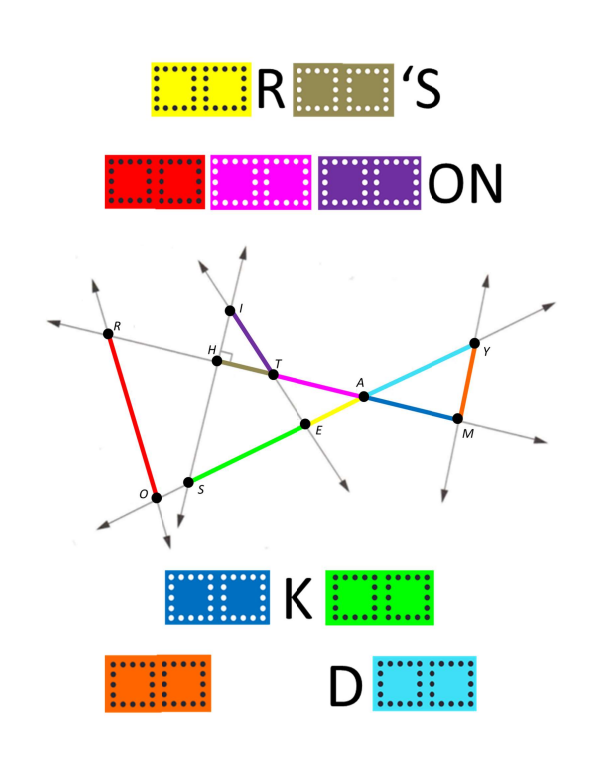
Naming Lines and Angles

Who knows if we will be online or in person this fall, but I had this idea a few months back and finally got around to building it. This first one students use angle naming conventions to spell out a dad joke.

This second one works much the same way with line naming conventions. (I think the angle one is better, but both are in the file at the top of this page)

Enjoy!

Triangles on Trial!

Bad boys, bad boys, what cha gonna do?  What cha gonna do when they come for you?

Triangles on trial (TOTs) is one of my favorite lessons ever, and it is all the brainchild of my old teaching partner Chris Bakke.  We were struggling to make triangle proofs engaging.  Necessity mothered this lovely invention, and TOTs was born.

This lesson came midyear, after a few big triangle ideas (congruency markings, sum of angles in a triangle etc) but before we had really jumped into the big ideas around triangle proofs or any of the formal proof writing.  We built out a bunch of these TOTs case files.  Each case file had security camera footage (featuring the guilty triangle) and below it, a lineup of potential perps.

tots

Each group got a different case file, and had to decide which of the suspect triangles was in the security footage, and which of the triangles were innocent.  Then, each group played attorney and presented their case to the class.

Obviously, we played the “bad boys” song from COPS on loop, and obviously we were dressed like judges the whole time.  Also, we had the “dun dun” law and order sound effect cued up on our phones and played it over and over and over.  Obviously.

Tots2

Some more TOTs are below in a ppt file, if you want to start up your own congruency courtroom in class.

ppt file: TOTS

Algebra 1 Catan!

Alright, I wanted to make a quick post about a math review game that I have been stewing over for most of this semester.  This year, I have been pushing myself to find more and more board game applications for my Algebra 1 and pre-algebra classes.  A few months back I found a Catan dice game at a local game store, and brought it for a weekend trip.

It’s a fun little game, and the rules are significantly simpler than the original Catan board game.  Some of the rules are as follows:

  • All the game boards look the same and each player/team gets one (below is the original board (left), and the larger one that we used in class)

IMG_7483

  • Players use resources to buy roads, settlements, cities and soldiers (soldiers have replaced development cards in the dice game)
  • Settlements are one point, cities are two.  Longest road and Biggest army are both worth 2 (all similar to original game).  First to ten points wins.

I began to scheme a classroom application, and yesterday, I got to try my Frankenstein creation for the first time.  I used the “red” player sheets from the dice game (shown above, blown up to 200% on our color copier and laminated) and most of the game mechanics from the dice game, with one big deviation: the kids had to EARN the resources with math (instead of just rolling dice) to build stuff.

I split the class into five teams, and each team received a game board and a deck of 25 custom question cards from the semester.  Each question card has a value in the bottom corner, so if students correctly answer the question, they earn the resource indicated in the bottom corner of the card, (and/or a randomized resource from rolling one of the dice from the dice game).

img_7482.jpg

The question cards were the part of this game that took a while to construct, but I am getting good with my PowerPoint formatting, and I am more than happy to share the ones that I built so you can use/modify for your own classroom.  They are included at the bottom of this post. (I think.  I’ve never tried to attach a ppt file before).

Students would solve math problems, trade correct solutions in for resource cards, and then cash those resources in for roads, settlements, cities and soldiers.  It was nerdy, it was chaos, it was wildly engaging, and the kids loved it.

IMG_2393

Things you would need to run this with your own class:

Unfettered access to a color printer and a laminator (which, for some reason, our principal gives me)

Dice game: https://catanshop.com/catan-dice-game-clamshell-edition

Resource cards: https://catanshop.com/catan-replacement-game-cards

In all, it cost me about 35 bucks, and about 8 hours of prep, but it is now a resource that I will have for every Algebra 1 class going forward, and it will be easy to modify for other math classes.

Some stray things:

  • Catan sells replacement cards, and I used the resource cards from that set as currency for the game. (I bought two packs to be sure I had enough)
  • Just as in the original game, teams could trade anything.  Question cards, resource cards, any combination.
  • This go around, I sorted the kids by tribes, where one team got all of the “brick” question cards one team got all of the “ore” question cards and so on.  This was fun (and I made them wear headbands showing their tribe) but it gave an unfair advantage to the brick and wood teams who could build roads and settlements way faster.  I think for next time, I will either add a 2-1 port, or give each group a question deck with cards that give them different resources.
  • I just finished the semester 2 cards, so if you want em, hit me up on twitter.
  • I loved this game, and am absolutely planning on running it again in the spring, but there was a large demand on the teacher.  Between checking answers, handing out resource cards, and marking off things teams had purchased on their game-boards for five teams, there wasn’t a dull moment.  I might look to assign a “banker” to hand out and collect resource cards next time.

Here are the slides that I used to introduce the game and the (edit-able) slides I printed to make my question cards.  The PDF has just the cards, if that’s how you rock.  Enjoy!

Catan Resources

Catan Cards


Sandwich Stack

Last week, I found an old tweet that I had bookmarked from Sarah Carter from her math equals love blog about a routine called question stack.  Students start with a problem, and solve it to find the next question in the stack.  I used it last year as part of a breakout edu box, and hadn’t returned to it since, but I had a few ideas this week to make it a bit more visual for my middle school classroom.

IMG_7425

This year, I’ve been making a monthly pilgrimage to Value Village to look for board games that I can incorporate into my classroom.  It has led to some fun classroom applications for Jenga, Battleship, Operation, Candyland, and now Slamwich (Settlers of Catan coming soon).  Slamwich is a card game where players stack various sandwich ingredients on top of one another.  For my application, I used the art to make the question stack routine much more (or less) appetizing.  My original idea was to print questions and answers on color copies of cards from the game, but I quickly realized that would be a waste of colored ink, especially when you only use the cards one lesson per year.

My big breakthrough came with these toploader card protectors.  Using these card holders means that the art could be affixed to the plastic sleeves, and the question/answer decks could be swapped out depending on the skill at hand.

IMG_7424

I copied the cards from the Slamwich game on our school’s color copier at 110% onto sticker paper and laminated them before slapping the sandwich ingredient stickers onto the plastic sleeves

img_7416.jpg

Finally, I made my first problems sets for my Algebra 1 classroom, and let them rip in class.  Kids loved the visuals and loved complaining about the combinations of ingredients as they uncovered each new card. (Onion plus jelly! ewwww) I’m hopeful this routine can become a regular!

Some resources (formatted question cards that fit into the plastic sandwich sleeves) if you’re into that sort of thing:

Line through two points sandwich stack

Equation Sandwich Stack