Color-by-Number Math

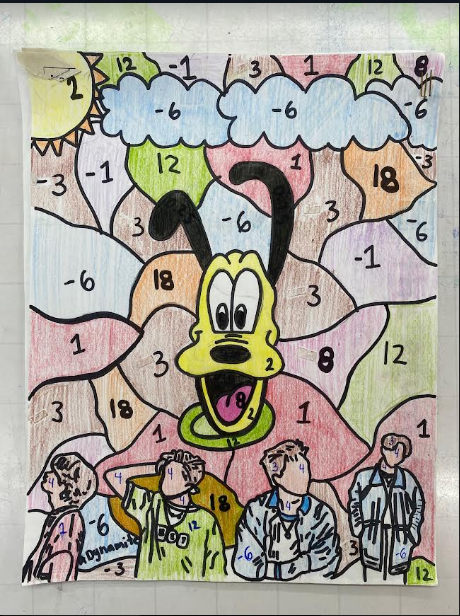
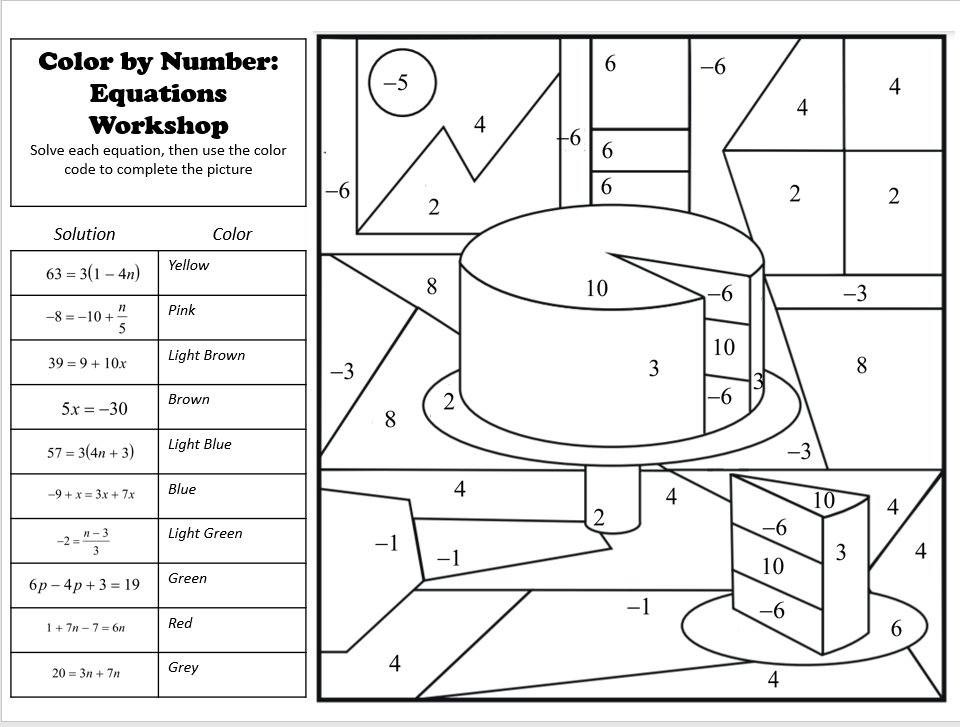
Color-by-number! With my writing, I have been playing around with ways to make the answer to a math problem something that is more interactive. Color by number is one thing that I stumbled upon last year, and I think it’s got some mad potential for older learners. (I freely admit that I am not the first teacher to create this. There are lots of TPT resources and freebies online, but they are generally reserved for younger grades and practicing basic operations. This resource I built out for my 8th graders practicing equations. The image is from a google image search and not my own):

The equations that students must solve are presented on the left. Once they solve an equation, they can color in the spaces with the corresponding color. (For example, the solution to 63=3(1-4n) is -5, so any space with a -5 on it should get colored in yellow.)

I used it as a part of a review project after we had spent a couple weeks solving equations. I put out a big bowl of colored pencils and let them dig in. took about 35 minutes to complete.

I also spent a two days where students built their own color by number math art. I gave parameters for the types of problems that they used, and asked them to build something creative. Some were better than others, but I absolutely need to share this color by number piece from Luz, cuz it rips.

It’s Pluto with some of the members of k-pop band BTS. Why are they all together? Ask Luz.

I’ve been sitting on this post for a WHILE because it is going to be a big part of my new Choose Your Own Adventure book, Fraction Action: Double Feature, and I didn’t want you vultures to steal all my good ideas 😉

Here is a downloadable pdf version of the “equations workshop” sheet shown above, and it has the problems in bigger boxes to be printed on the back.

Here is the powerpoint version if you want to add math that works better with your students! Enjoy!

Exponent Operation

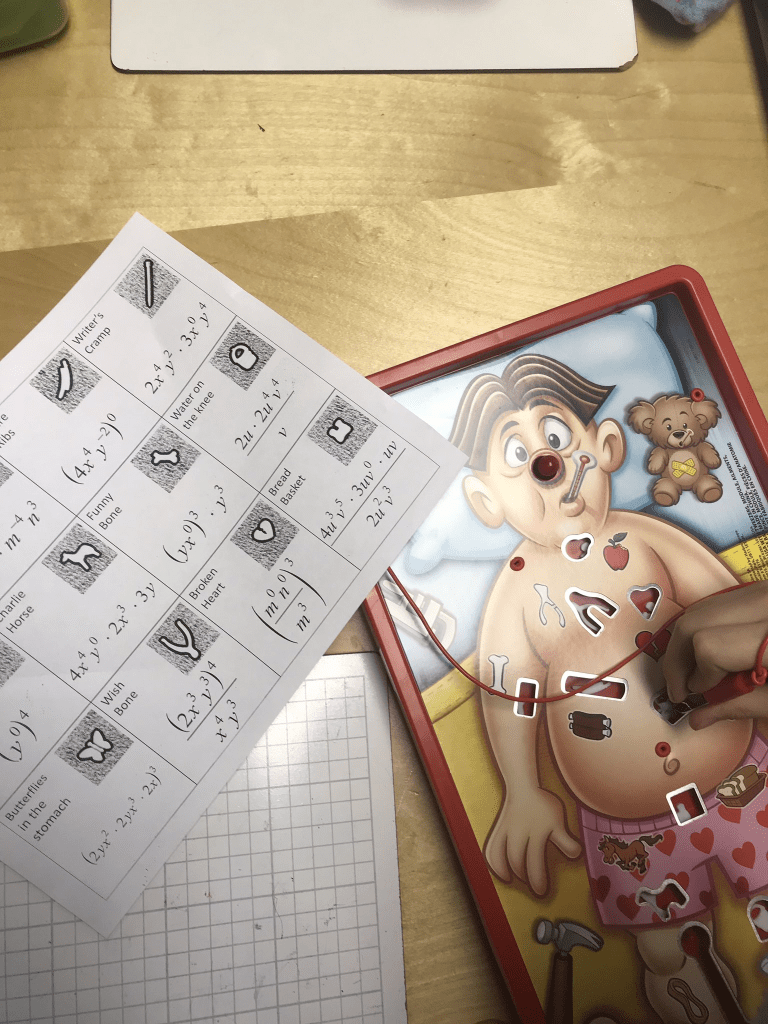
I made this little operation application a few years ago in Seattle. It was fun, and I used it every year for practicing exponent rules, but I never ended up building other stuff for other units. It would be very easy to do so.

WARNING: this game requires the game operation, which has lots of little pieces, and batteries. This game is fun, but not something that I think scales very well to a class of more than 12 or 15 kids.

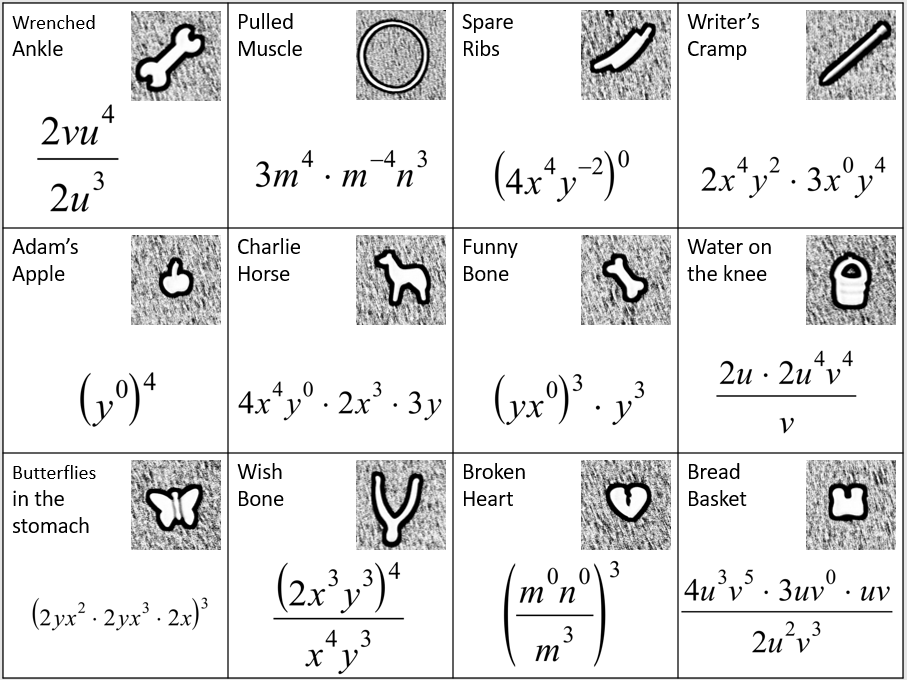
Anyway, you group kids, and have them take turns playing the game operation. If they successfully remove a piece from the board, the OTHER students must solve the corresponding problem from the sheet below.

I tried to attach the harder problems to the harder pieces from the gameboard to remove. There is also an answer key in the documents below that I printed out in a different color so kids could check their work.

Scrub up! It’s surgery time!

Hi-5, Low-5 (Connect 4)

I saw a copy of connect 4 in the duty-free store at the airport the other day, and it got my mind turning.

First, I should have bought connect 4 it at the airport. No dutys.

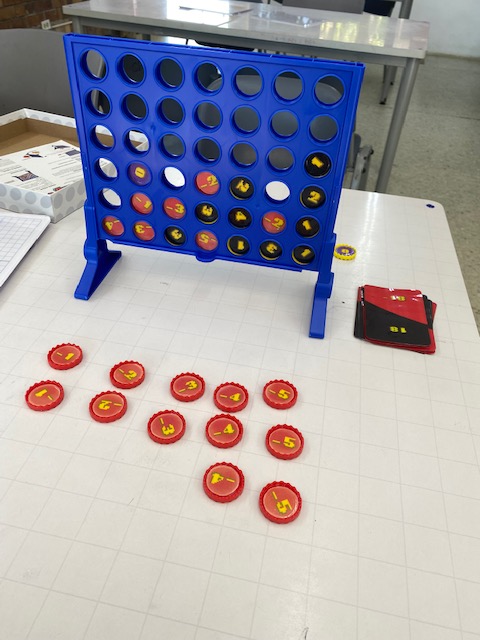
Second, it inspired me to make this integer practice game for my 6th/7th graders to practice with next year.

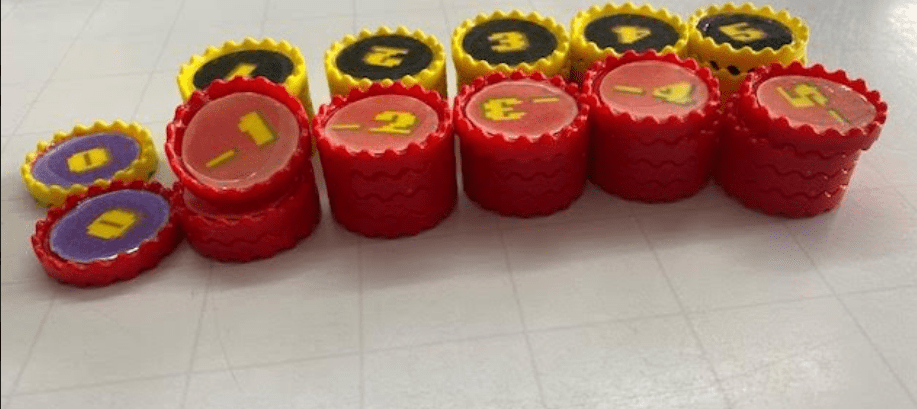
Rules are pretty similar to the original game. Players take turns dropping tokens into the gameboard. There are a few wrinkles to this version. One player uses the black tokens (positive) and the other player uses the (negative) red tokens. Right now, the set I made has 4 copies each of values from 1-5, plus a zero for each player.

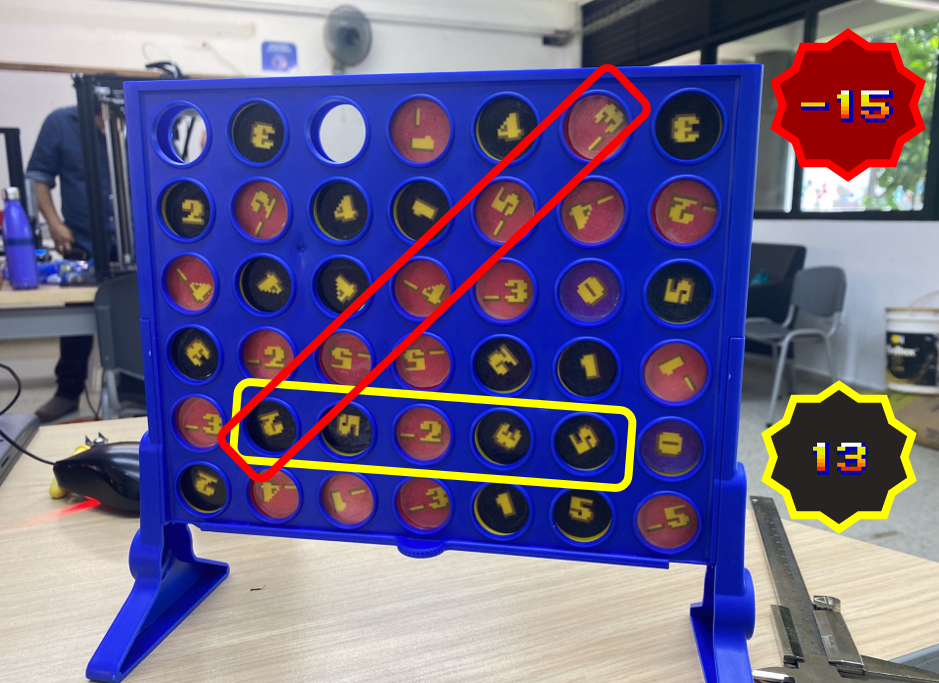
Each player is trying to place their tiles so they create a 5 token set (vertical horizontal or diagonal) with the greatest value. Red is trying to create the greatest negative number and black is trying to create the biggest positive number. It will be almost impossible to get five of your tokens in a row, so your score will likely include one or more of the other player’s tiles. Do you use your 5 token to build your own score, or play it defensively to block the other player? In the example gameboard below, the positive player was able to score 13. The negative player got to negative 15, so negative beats positive. Low-5 wins! Down low!

That’s about it. A lot of the best math thinking for this game comes from just looking at the board at the end and trying to optimize your score, but there is some really good strategy throughout the game too. Where do you use your fives? Where do you hide your zero and ones?

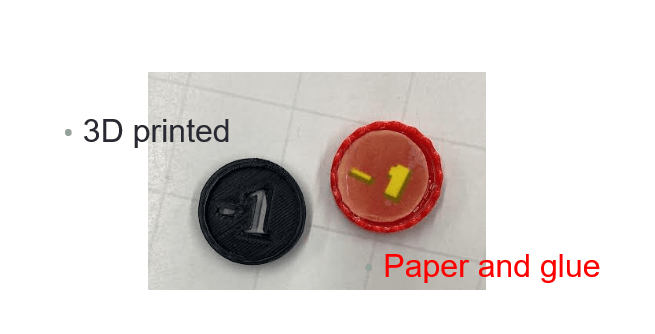
If you are interested in trying out this new connect 4 variant, I would love some help play-testing this bad boy. It’s fun, but there are almost certainly some other wrinkles that would make it even better. HMU with some feedback. Below are some printables so you can make your own integer connect 4 board at home. I laminated the little circles and then attached them to the tokens with Elmer’s glue.

I ALSO have been playing around with our school’s 3D printer, and I included some tinkercad files for pieces if you want to print out the pieces (with way less gluing!). The trial run came out pretty cool!

Negative tokens for a 3D printer: https://www.tinkercad.com/things/84fodAocHtN

Positive tokens for a 3D printer: https://www.tinkercad.com/things/g0lQZxJttw0

Segment Says

Shout out to Patricio, who came up with the idea for this game.

We are currently doing a little geometry mini-unit in 8th grade, and one of my students had this idea for a vocab game. We ran it today, and it rules.

It’s “Simon Says” but with some geometry themed prompts. Some of the ones that we used today were as follows:

“Segment says: Make a line” (lines continue forever in both directions, so students point with their fingers)

“Segment says: Make your line steeper.”

“Segment says: Make a line segment” (line segments terminate at both ends, so students ball up their fists)

Segment says: Make a ray that points to the door(One hand pointing, one hand is a fist)

“Segment says: Make a 90 degree angle”

“Segment says: Make a line with a slope of zero” (undefined works great too.)

“Segment says: Find a friend and make supplementary angles.”

“Make an obtuse angle.”

You’re out! I didn’t say “Segment says!”

Greed

I don’t even know where this game came from. I looked up greed dice games online, and this is not what popped up, so bear with me. This game is a great little strategy/luck game, and all you need is a couple of dice.

The rules are pretty simple.

-One player rolls both dice. If you are in the game, you get the points on the dice. 5 and a 2 is worth seven points. First to 100 wins. (Or, you can play to 200 for a longer game.)

-Doubles are worth double. For example: double fours are worth 16.

-BUT BE CAREFUL. If either dice comes up with a “1,” all standing players lose whatever points that they have earned that round.

-This is why the game is called greed. If the first three rolls are “5/2” and then “4/4” and then “3/6,” any players standing up have earned 7, 16 and 9 points for a total of 32 points. At any point, a player can leave the game to protect the points that they have earned. A “greedy” player will stay stay in the game longer, and risk their points against the dice.

-Once you decide to leave the game, you get to keep the points that you have earned, BUT you can’t earn any more points until a “1” is rolled and a new player starts rolling the dice. You are safe, but you might miss out on points.

-(One last rule: Double Ones on the dice cause all standing players to lose ALL points earned over all rounds. It is a fun hail-mary rule that can totally change the game)

I learned this game from a roommate in Seattle, and I have returned to it often. It’s a quick travel game, and it works with 2 players all the way up to a class full of kids.

With a class, I like to have the kids track their own scores and they show that they are in the game by standing up. (They sit to show that they are out of the game). It’s a fun little game if you find yourself with 20 minutes in class!

Tropical Vacation Barbie (Triangle Trig)

Been a while since I have posted about any of the escape rooms that I created in Seattle, but this one I finished last year is pretty fun. Normally, I make the boxes with scary or exciting premises (haunted mansions, deserted islands etc…) but this one uses a very different aesthetic.

Teach your color printer a lesson, and come join me in the Bahamas for Tropical Trigonometry Barbie!

Before you get too far in, this one is kindof a bear to put together. You will need a laminator, color printer, printable transparency paper and this thing:

here it is with the clues locked inside

I invented this because I wanted a way for the kids to earn each clue, one at a time. It works great for this box, and they were pretty easy to build. I used two old clipboards, cut them down to size, glued sections of meter stick along the sides, and drilled some holes in the top. This thing doesn’t have a name yet, so I’m taking submissions. Apologies that I didn’t take more pictures of the construction process, but “free math-based escape rooms” is a niche market. You get what you pay for.

Anyway, construction of the clues takes a minute as well. Print the five colorful triangles out on the transparency paper (amazon link: https://tinyurl.com/y2je2m7e), and cut them out.

I replaced all the triangles that you can see in the clues below with these transparent, colorful triangle windows before I laminated the clues. All the clues fit together to create complete colorful triangles, and students will need to earn ALL of the locked up clues to collect all the necessary triangle pieces and open up the final box.

The starting clue is this one: (3 digit: 430)

On the back of this clue is this:

For right now, they cannot complete the “smallest area to biggest area” puzzle, (because lots of information is missing), but the map on the back is solvable (430 miles). Once they solve the map, they can unlock the first lock that frees the second clue. Make sure you lock “clue 1” up with the three digit lock.

This one isn’t even really a clue at all, but I used a brad to attach the key to the lock. The lock unlocks the next lock (key lock) AND the blue and orange triangle bits are needed to solve the final puzzle (more on that soon)

Clue 2:

Make sure you lock up clue 2 with the key lock. Clue 2 asks students to compare trig ratios. The pink fish contains “sin a.” Using the diagrams above, you can see that the value of sina is equal to 3/5. If you follow the equivalent fish (cos c, 3/5, sin x, 0.6, cos z) you trace out a path that is R,D,D,L,L, and that will be the combination on the direction lock keeping clue 3 locked up. Also notice a piece of the green triangle is hiding on there. This clue also fits against the side of the area clue that the students started with.

Clue 3: Make sure that you lock up clue three with the direction lock.

I spent an embarrassing amount of time looking for one last good image to use with this box, and this is a screengrab from the Netflix Barbie movie “A Mermaid Tale.” These are the things I do for my students. The missing angle is about 37 degrees, and the missing side is about 46, making the combination 4637. This unlocks one of the two locks on the hasp/box.

In order to unlock the other lock, the students will need to piece together the triangle pieces that can be found on each one of the clues. When you arrange the clues like this

…The triangles line up and you can find the areas. From smallest to largest area, the triangles are ordered Pink, Green, Orange, Yellow, Blue. That same order of colors is the combination on the FINAL lock (5 digit, color)..

As always, If you have any ideas for other clues that would fit with this content and this theme, hit me up on twitter. I’m always looking for more ideas.  Otherwise, below is a ppt and pdf of the clues explained above.  Enjoy!

ppt

pdf
Open Middle VERSUS

Many of you have probably used Robert Kaplinsky and Nanette Johnson’s wonderful Open Middle math problems. There are great problems and resources for running these problems with students on the open middle website and in Robert’s book.

The best ones are on their site, but I have made a few that I shared on my twitter.

The idea I had last week was to think about “playing” this problem against someone else. OPEN MIDDLE VERSUS.

I haven’t tried anything like this with students yet, but I think it could be a fun extra layer. Not only do students need to figure out which digits they need to create a large value for x (9, 8 and 1) but they need to figure out how the numbers play together, and which one is the most important to creating a big value for x. I think the 1 is most important, so maybe this version of this problem would drive a better discussion:

I think it could lead to some fun discussions in class, and you could use this for any type of open middle problem that uses 3 or 4 numbers:

Again, 1 is going to be very important. Is there a reason why?

Walter Joris Puzzles

I cannot take credit for any of this. I just loved playing around with these games with my students and I formatted them into a ppt file.

I stumbled across this incredible Ben Orlin blog post while I was poking through Desmos activities to run the first day of this new semester. Go read it. It’s funny, and gives descriptions of six delightful 1 vs 1 games from game designer Walter Joris.

I ended up formatting the instructions to these games into a powerpoint with Ben’s drawings so that I could project them onto the board for my students. The first day back, I brought a ream of blank paper and a bag of bon-bon-booms as prizes. (If you’ve been to a tienda in south america, you get it. The red ones are best.)

I drew a bracket on the board with student names, and after each game, the winner moved on. The detailed instructions are in the blog post linked above, but the ppt file is linked below. Black hole was our favorite game, but “collector” wasn’t far behind.

Featured

The Dregg Disaster

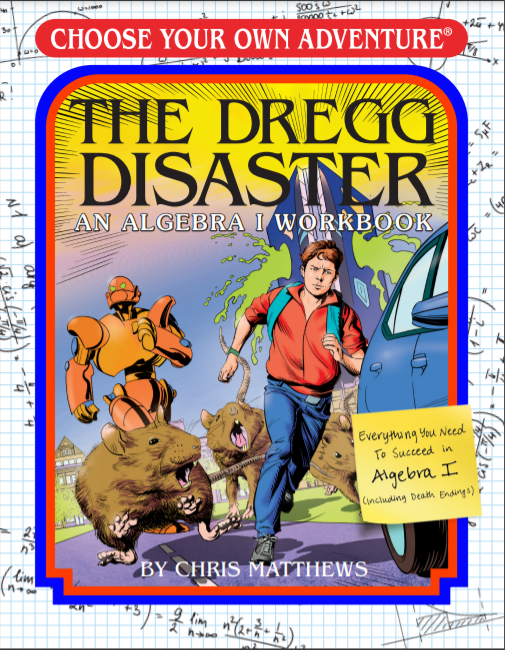
I wrote a book!

We have the story edits finalized and it is officially available for pre-order, which is pretty crazy. I WROTE A BOOK! It will be officially available sometime this year (looking like October), and I hope that my vision for this book translates to a fun, rigorous, Algebra 1 review. I am filled with so many emotions! I’m thrilled to share this vision of gamified math with readers, and I am so excited to actually hold something in my hand after the countless hours and frustrations that it took to put all the pieces of this project together. It’s been two and a half years since I first started working on this book as a side-project to my teaching job, which is a long time.

Enough time -in fact- to get engaged, cut my hair into a mullet, change jobs and move to a new country.

Most of all though, I cannot wait to see how students connect with it. I hope that students that already love math will find a book of puzzles that speaks a language that they understand. I hope that reluctant math learners will find a story that motivates them to learn new things.

Here’s a link to the book on the CYOA website, and it’s also on Amazon, if you want to help Bezos go back to space:

I don’t think that there has ever been a book quite like this one, so I made a few FAQ’s

Q: Is it a math book, or is it a Choose Your Own Adventure book?

A: Yes? Both. It has pictures, it has a silly adventure narrative with an evil corporation, talking animals, laser robots, shrink rays and mysterious portals. It also has Algebra-1 level math problems (and a free workbook download where kids can show their work and get more practice on each type of math problem that shows up in the story).

Here is a picture of what we are working with on the first page:

As you can see, there is a narrative section, and below that, a math problem

Students need to solve the math problem, and the the answer is the page where the story continues. The solution on this page is 13, so you would turn to page 13 to continue reading. Students will need to practice their algebra 1 skills to navigate through the book.

Q: ??? What ???

A: This book works like a normal CYOA book, with math as the connective tissue. The page numbers are the answers to the problems in the book. Read some story. Solve a math problem. Continue to a new page.

It is broken into four chapters. Each chapter includes death endings and choices that the reader will need to make to take on the nefarious Dregg Corporation. In addition, the types of math problems change from chapter to chapter. The first chapter focuses on equations, the second focuses on slope and lines, the third is quadratics, and the fourth is data and frequency tables. Every pathway through each chapter hits the same sequence of math problems, regardless of choices made by the reader.

Or maybe you die. It’s a CYOA book.

Every pathway follows the exact same sequence of math standards, but contains different story choices. The answer to each problem leads you to the next page in the story. New page, new story and new math skill.

Q: What if I get stuck?

A: Each chapter has an “Adventure Advice” section that explains the problem types found in each chapter, and serves as an answer key. If you don’t understand every problem type in the book, that’s okay! This is intended as a learning resource.

THANK YOUS. I did not do this alone.

Thanks to Shannon, Rachel, Melissa and Julie for helping this book take shape. I am very grateful to Shannon in particular for seeing value in this idea, and helping it to reach the finish line. Thanks too to my math brother, Chris Bakke for helping pick the math standards, and create some of the math problems. I still haven’t seen most of the art, but thanks too to the artists. Eoin Coveney did the cover, and Maria Pesado did all the illustrations inside the book, AND she re-drew all the math problems so that they pop. I hope that you like what we have been able to create!

Naming Lines and Angles

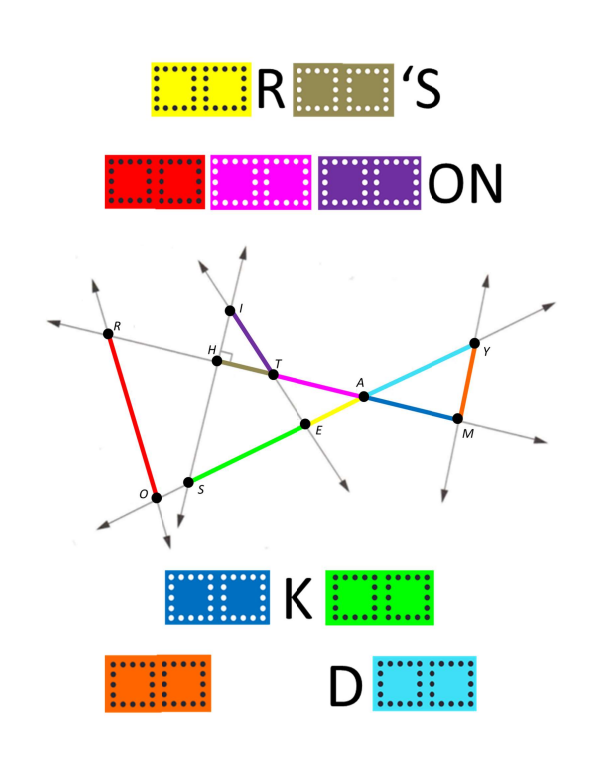
Who knows if we will be online or in person this fall, but I had this idea a few months back and finally got around to building it. This first one students use angle naming conventions to spell out a dad joke.

This second one works much the same way with line naming conventions. (I think the angle one is better, but both are in the file at the top of this page)

Enjoy!