Color-by-Number Math

Color-by-number! With my writing, I have been playing around with ways to make the answer to a math problem something that is more interactive. Color by number is one thing that I stumbled upon last year, and I think it’s got some mad potential for older learners. (I freely admit that I am not the first teacher to create this. There are lots of TPT resources and freebies online, but they are generally reserved for younger grades and practicing basic operations. This resource I built out for my 8th graders practicing equations. The image is from a google image search and not my own):
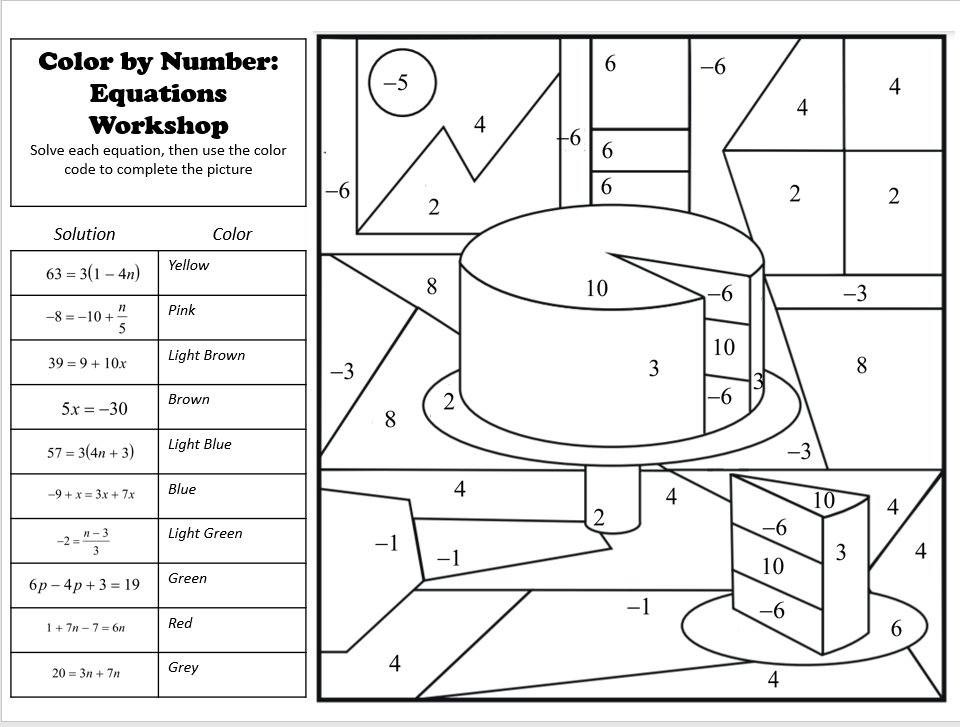
The equations that students must solve are presented on the left. Once they solve an equation, they can color in the spaces with the corresponding color. (For example, the solution to 63=3(1-4n) is -5, so any space with a -5 on it should get colored in yellow.)

I used it as a part of a review project after we had spent a couple weeks solving equations. I put out a big bowl of colored pencils and let them dig in. took about 35 minutes to complete.

I also spent a two days where students built their own color by number math art. I gave parameters for the types of problems that they used, and asked them to build something creative. Some were better than others, but I absolutely need to share this color by number piece from Luz, cuz it rips.
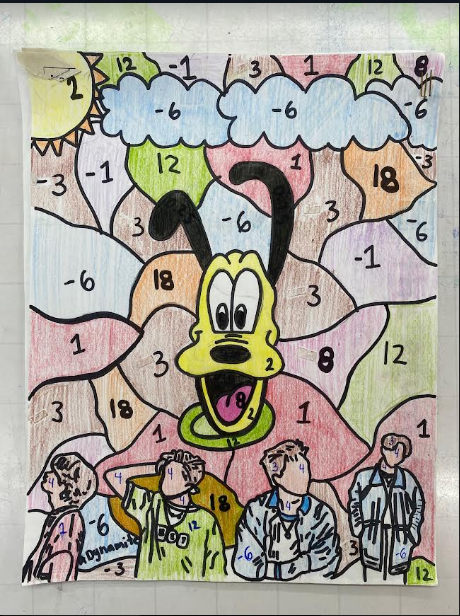
It’s Pluto with some of the members of k-pop band BTS. Why are they all together? Ask Luz.

I’ve been sitting on this post for a WHILE because it is going to be a big part of my new Choose Your Own Adventure book, Fraction Action: Double Feature, and I didn’t want you vultures to steal all my good ideas 😉

Here is a downloadable pdf version of the “equations workshop” sheet shown above, and it has the problems in bigger boxes to be printed on the back.

Here is the powerpoint version if you want to add math that works better with your students! Enjoy!
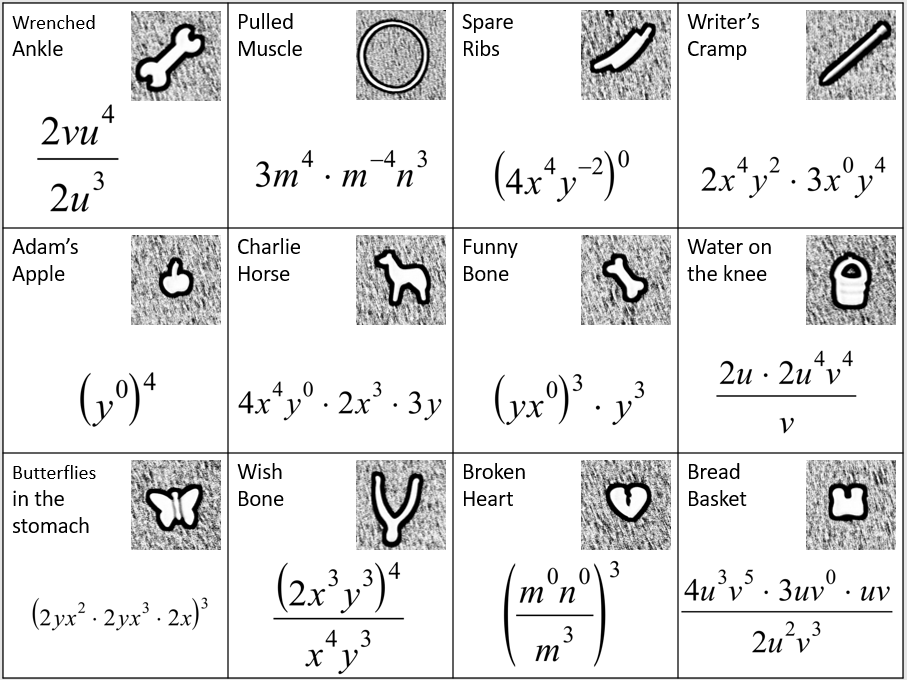
Exponent Operation

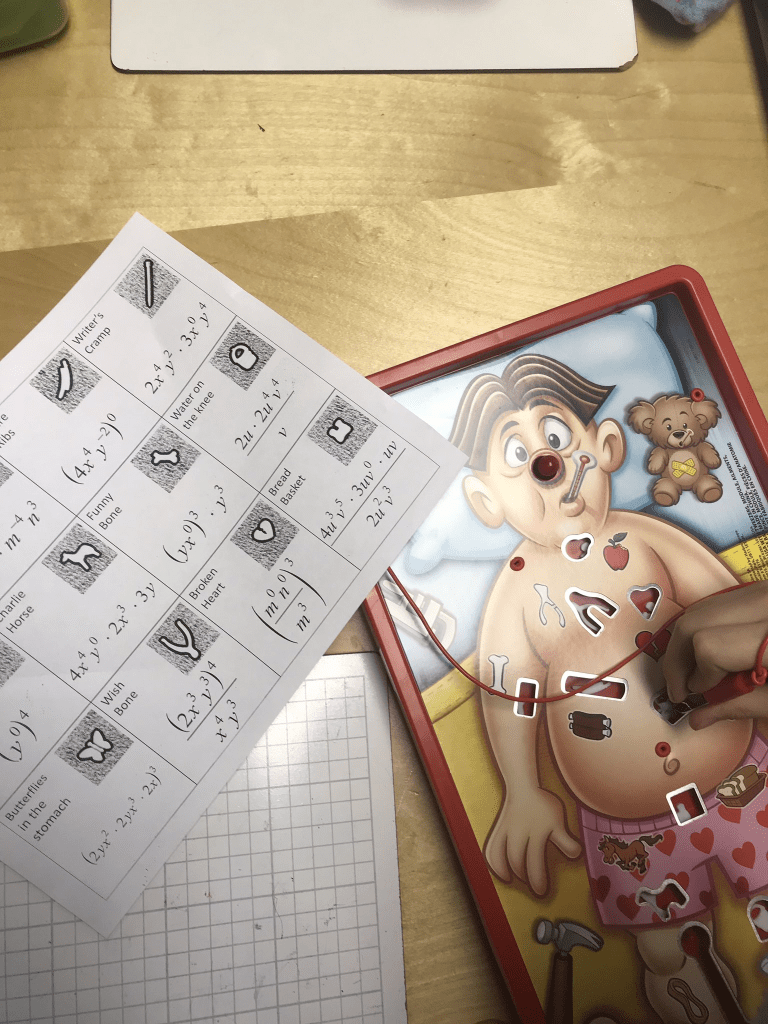
I made this little operation application a few years ago in Seattle. It was fun, and I used it every year for practicing exponent rules, but I never ended up building other stuff for other units. It would be very easy to do so.

WARNING: this game requires the game operation, which has lots of little pieces, and batteries. This game is fun, but not something that I think scales very well to a class of more than 12 or 15 kids.

Anyway, you group kids, and have them take turns playing the game operation. If they successfully remove a piece from the board, the OTHER students must solve the corresponding problem from the sheet below.

I tried to attach the harder problems to the harder pieces from the gameboard to remove. There is also an answer key in the documents below that I printed out in a different color so kids could check their work.

Scrub up! It’s surgery time!

Hi-5, Low-5 (Connect 4)

I saw a copy of connect 4 in the duty-free store at the airport the other day, and it got my mind turning.

First, I should have bought connect 4 it at the airport. No dutys.

Second, it inspired me to make this integer practice game for my 6th/7th graders to practice with next year.

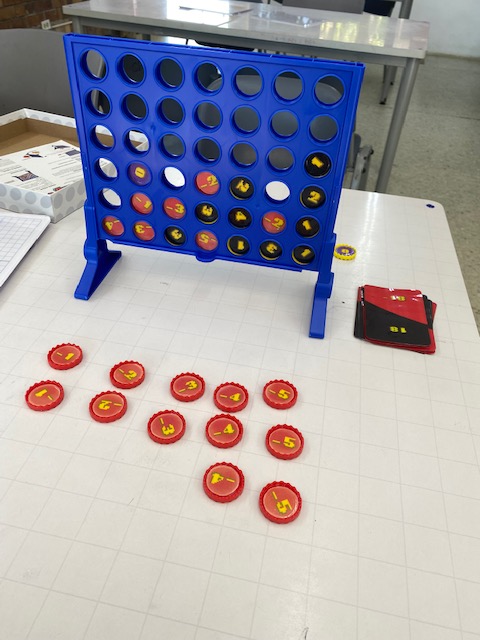
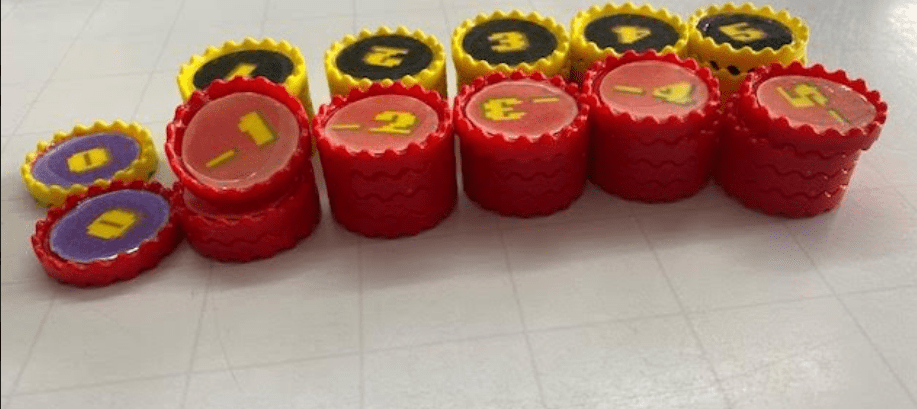
Rules are pretty similar to the original game. Players take turns dropping tokens into the gameboard. There are a few wrinkles to this version. One player uses the black tokens (positive) and the other player uses the (negative) red tokens. Right now, the set I made has 4 copies each of values from 1-5, plus a zero for each player.

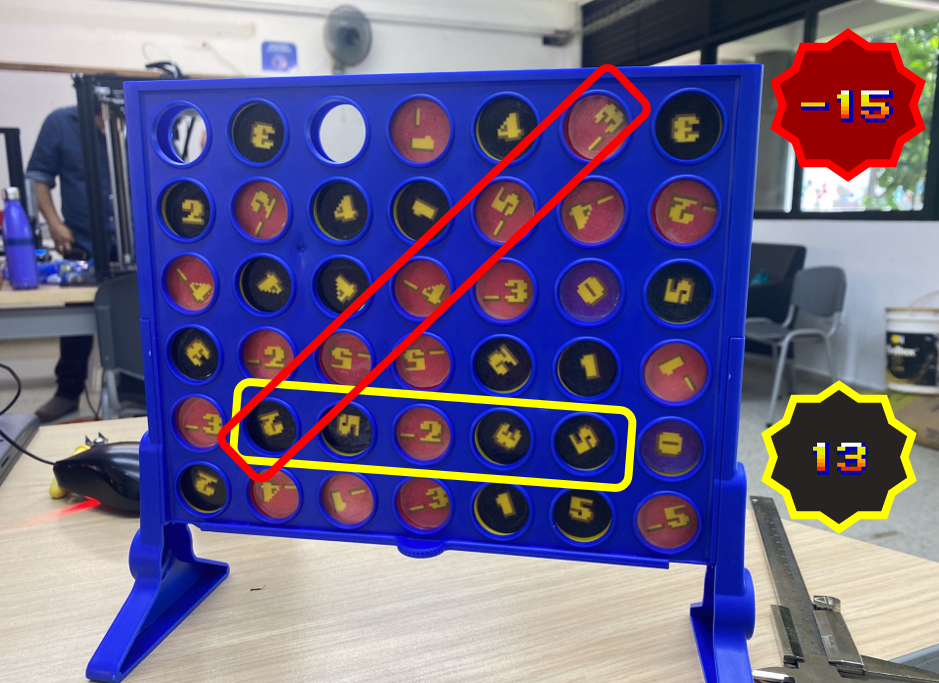
Each player is trying to place their tiles so they create a 5 token set (vertical horizontal or diagonal) with the greatest value. Red is trying to create the greatest negative number and black is trying to create the biggest positive number. It will be almost impossible to get five of your tokens in a row, so your score will likely include one or more of the other player’s tiles. Do you use your 5 token to build your own score, or play it defensively to block the other player? In the example gameboard below, the positive player was able to score 13. The negative player got to negative 15, so negative beats positive. Low-5 wins! Down low!

That’s about it. A lot of the best math thinking for this game comes from just looking at the board at the end and trying to optimize your score, but there is some really good strategy throughout the game too. Where do you use your fives? Where do you hide your zero and ones?

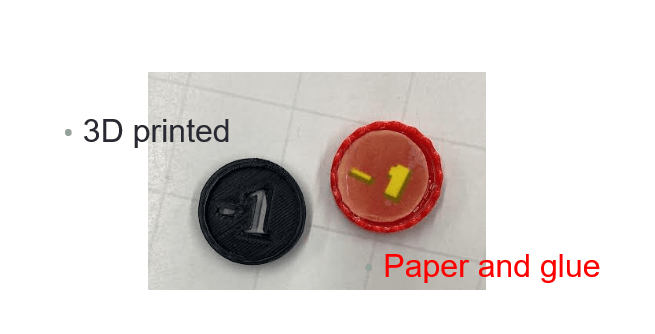
If you are interested in trying out this new connect 4 variant, I would love some help play-testing this bad boy. It’s fun, but there are almost certainly some other wrinkles that would make it even better. HMU with some feedback. Below are some printables so you can make your own integer connect 4 board at home. I laminated the little circles and then attached them to the tokens with Elmer’s glue.

I ALSO have been playing around with our school’s 3D printer, and I included some tinkercad files for pieces if you want to print out the pieces (with way less gluing!). The trial run came out pretty cool!

Negative tokens for a 3D printer: https://www.tinkercad.com/things/84fodAocHtN

Positive tokens for a 3D printer: https://www.tinkercad.com/things/g0lQZxJttw0

Greed

I don’t even know where this game came from. I looked up greed dice games online, and this is not what popped up, so bear with me. This game is a great little strategy/luck game, and all you need is a couple of dice.

The rules are pretty simple.

-One player rolls both dice. If you are in the game, you get the points on the dice. 5 and a 2 is worth seven points. First to 100 wins. (Or, you can play to 200 for a longer game.)

-Doubles are worth double. For example: double fours are worth 16.

-BUT BE CAREFUL. If either dice comes up with a “1,” all standing players lose whatever points that they have earned that round.

-This is why the game is called greed. If the first three rolls are “5/2” and then “4/4” and then “3/6,” any players standing up have earned 7, 16 and 9 points for a total of 32 points. At any point, a player can leave the game to protect the points that they have earned. A “greedy” player will stay stay in the game longer, and risk their points against the dice.

-Once you decide to leave the game, you get to keep the points that you have earned, BUT you can’t earn any more points until a “1” is rolled and a new player starts rolling the dice. You are safe, but you might miss out on points.

-(One last rule: Double Ones on the dice cause all standing players to lose ALL points earned over all rounds. It is a fun hail-mary rule that can totally change the game)

I learned this game from a roommate in Seattle, and I have returned to it often. It’s a quick travel game, and it works with 2 players all the way up to a class full of kids.

With a class, I like to have the kids track their own scores and they show that they are in the game by standing up. (They sit to show that they are out of the game). It’s a fun little game if you find yourself with 20 minutes in class!

Walter Joris Puzzles

I cannot take credit for any of this. I just loved playing around with these games with my students and I formatted them into a ppt file.

I stumbled across this incredible Ben Orlin blog post while I was poking through Desmos activities to run the first day of this new semester. Go read it. It’s funny, and gives descriptions of six delightful 1 vs 1 games from game designer Walter Joris.

I ended up formatting the instructions to these games into a powerpoint with Ben’s drawings so that I could project them onto the board for my students. The first day back, I brought a ream of blank paper and a bag of bon-bon-booms as prizes. (If you’ve been to a tienda in south america, you get it. The red ones are best.)

I drew a bracket on the board with student names, and after each game, the winner moved on. The detailed instructions are in the blog post linked above, but the ppt file is linked below. Black hole was our favorite game, but “collector” wasn’t far behind.

Qwixx (Special Boards)

Ten years ago, I found the game Qwixx at a game shop in Seattle. The bright colors on the box sucked me in. It is the perfect mix of strategy and luck, and it has a ton of replay value. It’s a seriously great game.

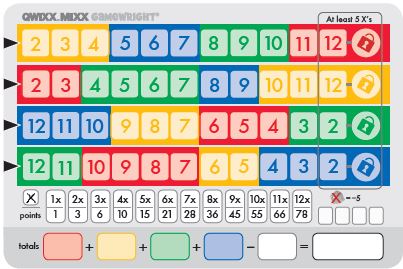
They have been making a bunch of expansions for it (especially in Europe), and me and my buddy Chris Bakke found a version where the colors are all scrambled around. It’s called “qwixx mixx.” and it looks like this:

How to play Qwixx Deluxe | Official Rules | UltraBoardGames

The color of each space corresponds to a dice color, and in this version, instead of closing out a “row” you close out a “color.” (Full rules for these boards are available here) It’s a fun wrinkle, and we started talking about what OTHER ways you could reconfigure the colors of the board. Like, why can’t you play with a board that looks like this?:

Or this one:

I ended up using ppt and making a bunch of the patterns that we talked about. I printed them on cardstock, and laminated the fronts, so we could use them with dry erase markers. If you print them from the pdf (or “2 slides per page from the ppt) they are the perfect size to fit in the box that comes with the game. Now when we play, we start by drawing a board at random from the deck of 12 or so boards that we created. Your board doesn’t match your opponents, but the probabilities are similar (or the same) and it makes every game a little different. I love the added variety, and because all this fits in the little box, it’s a game that Emily and I bring with us whenever we go anywhere.

Also, the best image of a qwixx board that I was able to find at the time is in dutch, so as an added punishment for taking a strike you have to try to pronounce “Elke mislukte worp.”