Exponent Operation

I made this little operation application a few years ago in Seattle. It was fun, and I used it every year for practicing exponent rules, but I never ended up building other stuff for other units. It would be very easy to do so.

WARNING: this game requires the game operation, which has lots of little pieces, and batteries. This game is fun, but not something that I think scales very well to a class of more than 12 or 15 kids.

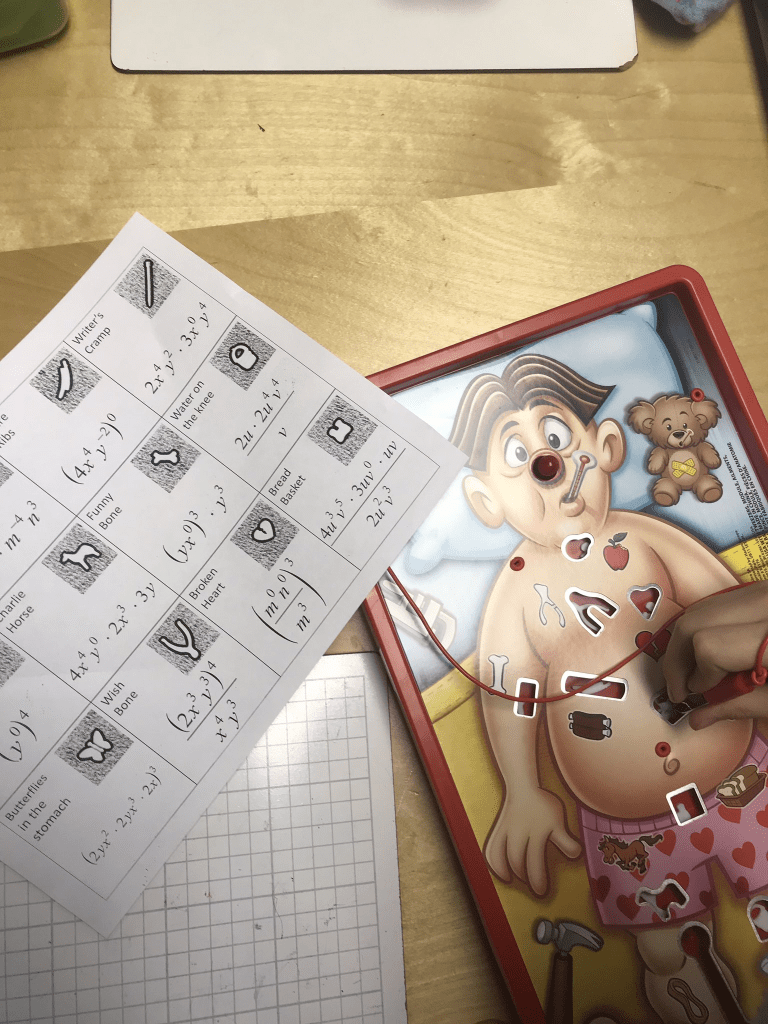
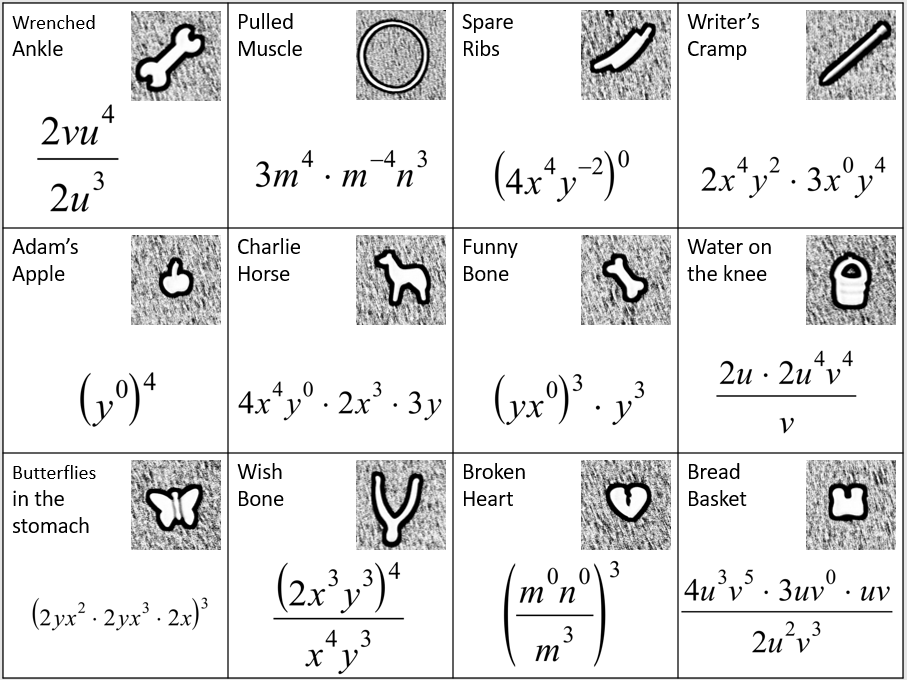
Anyway, you group kids, and have them take turns playing the game operation. If they successfully remove a piece from the board, the OTHER students must solve the corresponding problem from the sheet below.

I tried to attach the harder problems to the harder pieces from the gameboard to remove. There is also an answer key in the documents below that I printed out in a different color so kids could check their work.

Scrub up! It’s surgery time!

Hi-5, Low-5 (Connect 4)

I saw a copy of connect 4 in the duty-free store at the airport the other day, and it got my mind turning.

First, I should have bought connect 4 it at the airport. No dutys.

Second, it inspired me to make this integer practice game for my 6th/7th graders to practice with next year.

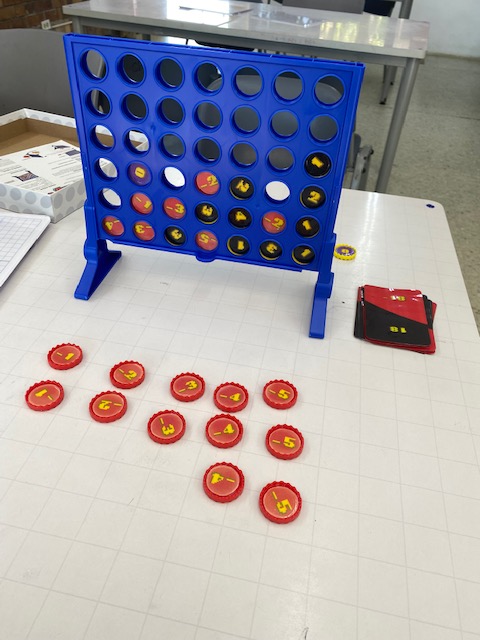
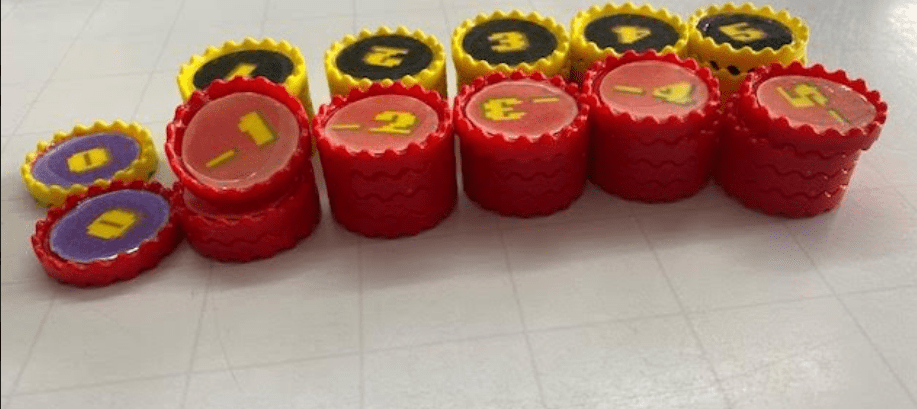
Rules are pretty similar to the original game. Players take turns dropping tokens into the gameboard. There are a few wrinkles to this version. One player uses the black tokens (positive) and the other player uses the (negative) red tokens. Right now, the set I made has 4 copies each of values from 1-5, plus a zero for each player.

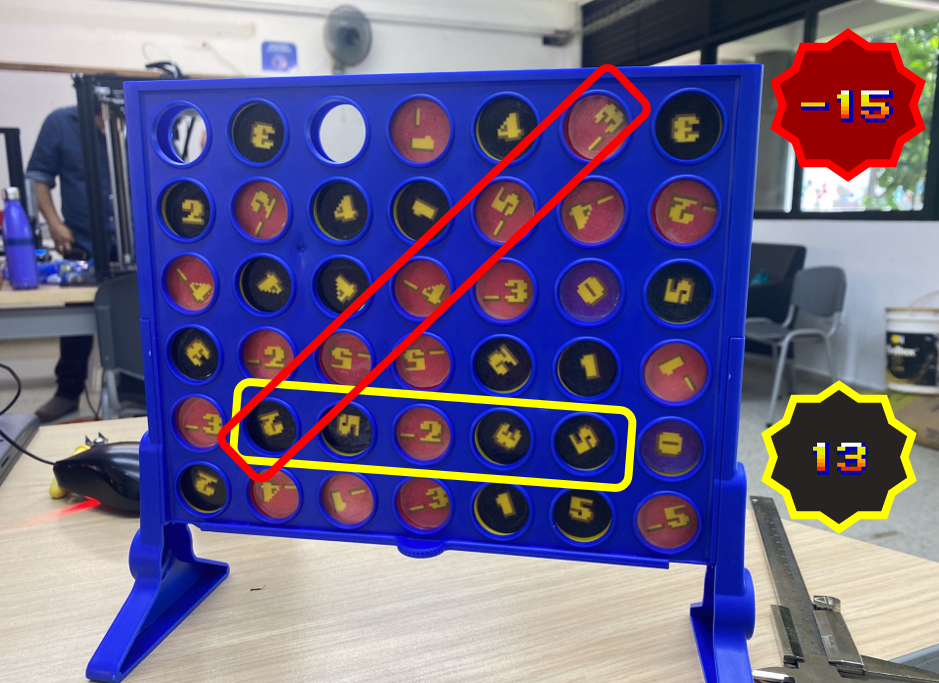
Each player is trying to place their tiles so they create a 5 token set (vertical horizontal or diagonal) with the greatest value. Red is trying to create the greatest negative number and black is trying to create the biggest positive number. It will be almost impossible to get five of your tokens in a row, so your score will likely include one or more of the other player’s tiles. Do you use your 5 token to build your own score, or play it defensively to block the other player? In the example gameboard below, the positive player was able to score 13. The negative player got to negative 15, so negative beats positive. Low-5 wins! Down low!

That’s about it. A lot of the best math thinking for this game comes from just looking at the board at the end and trying to optimize your score, but there is some really good strategy throughout the game too. Where do you use your fives? Where do you hide your zero and ones?

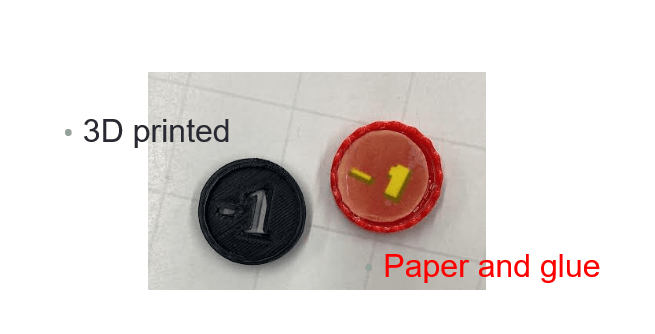
If you are interested in trying out this new connect 4 variant, I would love some help play-testing this bad boy. It’s fun, but there are almost certainly some other wrinkles that would make it even better. HMU with some feedback. Below are some printables so you can make your own integer connect 4 board at home. I laminated the little circles and then attached them to the tokens with Elmer’s glue.

I ALSO have been playing around with our school’s 3D printer, and I included some tinkercad files for pieces if you want to print out the pieces (with way less gluing!). The trial run came out pretty cool!

Negative tokens for a 3D printer: https://www.tinkercad.com/things/84fodAocHtN

Positive tokens for a 3D printer: https://www.tinkercad.com/things/g0lQZxJttw0

Featured

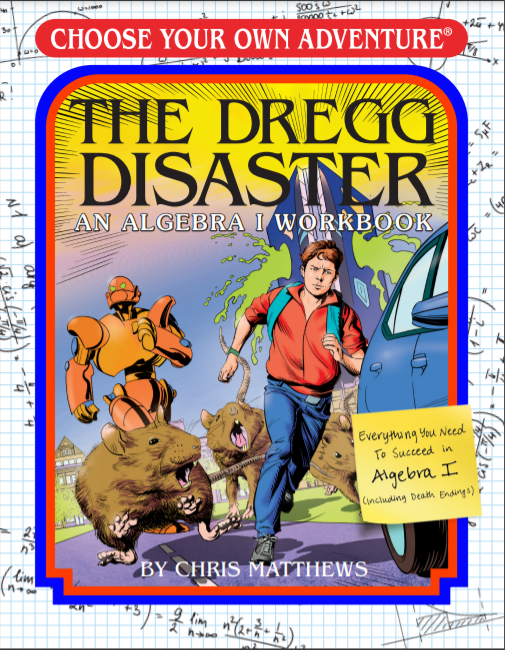
The Dregg Disaster

I wrote a book!

We have the story edits finalized and it is officially available for pre-order, which is pretty crazy. I WROTE A BOOK! It will be officially available sometime this year (looking like October), and I hope that my vision for this book translates to a fun, rigorous, Algebra 1 review. I am filled with so many emotions! I’m thrilled to share this vision of gamified math with readers, and I am so excited to actually hold something in my hand after the countless hours and frustrations that it took to put all the pieces of this project together. It’s been two and a half years since I first started working on this book as a side-project to my teaching job, which is a long time.

Enough time -in fact- to get engaged, cut my hair into a mullet, change jobs and move to a new country.

Most of all though, I cannot wait to see how students connect with it. I hope that students that already love math will find a book of puzzles that speaks a language that they understand. I hope that reluctant math learners will find a story that motivates them to learn new things.

Here’s a link to the book on the CYOA website, and it’s also on Amazon, if you want to help Bezos go back to space:

I don’t think that there has ever been a book quite like this one, so I made a few FAQ’s

Q: Is it a math book, or is it a Choose Your Own Adventure book?

A: Yes? Both. It has pictures, it has a silly adventure narrative with an evil corporation, talking animals, laser robots, shrink rays and mysterious portals. It also has Algebra-1 level math problems (and a free workbook download where kids can show their work and get more practice on each type of math problem that shows up in the story).

Here is a picture of what we are working with on the first page:

As you can see, there is a narrative section, and below that, a math problem

Students need to solve the math problem, and the the answer is the page where the story continues. The solution on this page is 13, so you would turn to page 13 to continue reading. Students will need to practice their algebra 1 skills to navigate through the book.

Q: ??? What ???

A: This book works like a normal CYOA book, with math as the connective tissue. The page numbers are the answers to the problems in the book. Read some story. Solve a math problem. Continue to a new page.

It is broken into four chapters. Each chapter includes death endings and choices that the reader will need to make to take on the nefarious Dregg Corporation. In addition, the types of math problems change from chapter to chapter. The first chapter focuses on equations, the second focuses on slope and lines, the third is quadratics, and the fourth is data and frequency tables. Every pathway through each chapter hits the same sequence of math problems, regardless of choices made by the reader.

Or maybe you die. It’s a CYOA book.

Every pathway follows the exact same sequence of math standards, but contains different story choices. The answer to each problem leads you to the next page in the story. New page, new story and new math skill.

Q: What if I get stuck?

A: Each chapter has an “Adventure Advice” section that explains the problem types found in each chapter, and serves as an answer key. If you don’t understand every problem type in the book, that’s okay! This is intended as a learning resource.

THANK YOUS. I did not do this alone.

Thanks to Shannon, Rachel, Melissa and Julie for helping this book take shape. I am very grateful to Shannon in particular for seeing value in this idea, and helping it to reach the finish line. Thanks too to my math brother, Chris Bakke for helping pick the math standards, and create some of the math problems. I still haven’t seen most of the art, but thanks too to the artists. Eoin Coveney did the cover, and Maria Pesado did all the illustrations inside the book, AND she re-drew all the math problems so that they pop. I hope that you like what we have been able to create!
Qwixx (Special Boards)

Ten years ago, I found the game Qwixx at a game shop in Seattle. The bright colors on the box sucked me in. It is the perfect mix of strategy and luck, and it has a ton of replay value. It’s a seriously great game.

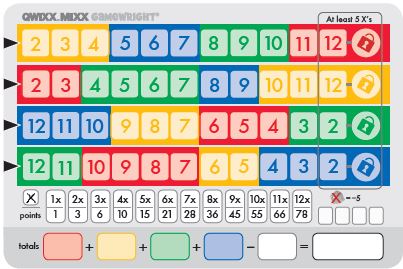
They have been making a bunch of expansions for it (especially in Europe), and me and my buddy Chris Bakke found a version where the colors are all scrambled around. It’s called “qwixx mixx.” and it looks like this:

How to play Qwixx Deluxe | Official Rules | UltraBoardGames

The color of each space corresponds to a dice color, and in this version, instead of closing out a “row” you close out a “color.” (Full rules for these boards are available here) It’s a fun wrinkle, and we started talking about what OTHER ways you could reconfigure the colors of the board. Like, why can’t you play with a board that looks like this?:

Or this one:

I ended up using ppt and making a bunch of the patterns that we talked about. I printed them on cardstock, and laminated the fronts, so we could use them with dry erase markers. If you print them from the pdf (or “2 slides per page from the ppt) they are the perfect size to fit in the box that comes with the game. Now when we play, we start by drawing a board at random from the deck of 12 or so boards that we created. Your board doesn’t match your opponents, but the probabilities are similar (or the same) and it makes every game a little different. I love the added variety, and because all this fits in the little box, it’s a game that Emily and I bring with us whenever we go anywhere.

Also, the best image of a qwixx board that I was able to find at the time is in dutch, so as an added punishment for taking a strike you have to try to pronounce “Elke mislukte worp.”