I wanted to share my favorite classroom game for those days at the end of the semester where you need to fill some time with some lite math. (It’s my 5×5) It’s one that I stole from my old camp buddy Garrett Mandeville. He’s a sweetie, and he shared this game with me my first year teaching. It’s a simple one to run, and the kids that I have played it with at every level have LOVED it. It didn’t have a name when he gave it to me, but I slapped a 2001 TV reference on it, and posted it here for internet points.
The setup is pretty simple. You think of a number, and write it on a post-it that goes in your pocket. The kids get a handout. All that’s on it is a 1-100 grid. I generally print them four on a page so you can play a few rounds.
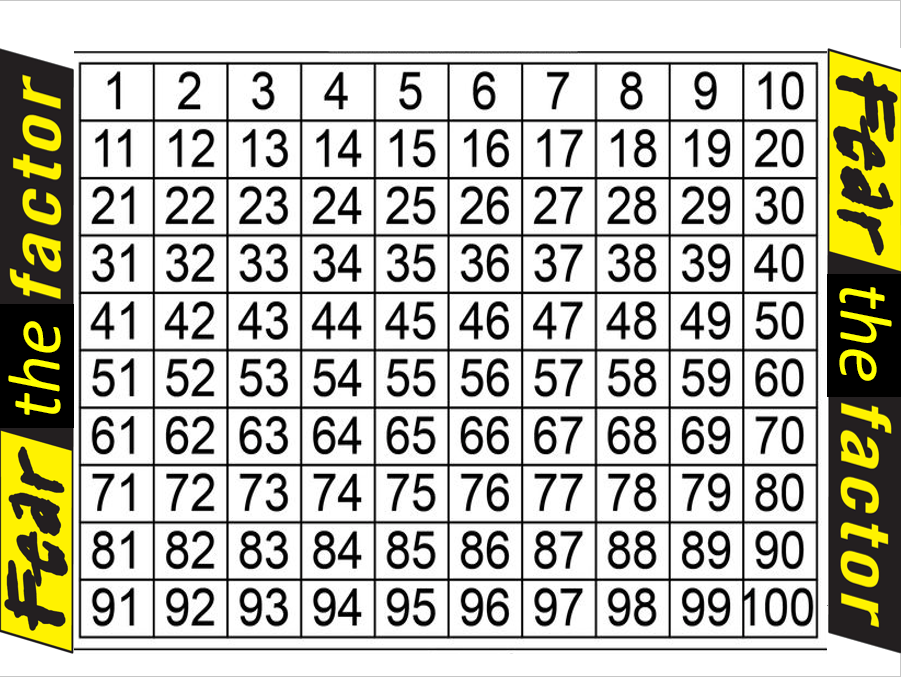
Students are in groups of 4, and their task is to guess your number. BUT they get some help from factors. Each team gets a turn and their turn goes like this:
1: They get to ask about one factor. (example: Is 5 a factor of your number?)
2: They get one guess (example: Is 37 your number?)
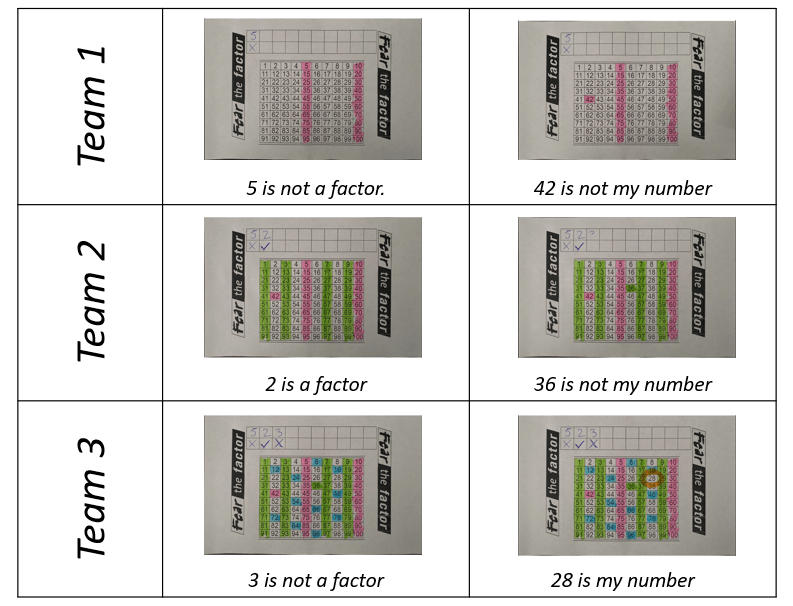
If they guess the number, they win! If not, it moves on to the next team. The first round, I play along on the whiteboard, crossing off the numbers that are eliminated with each factor and with each guess. Subsequent rounds, I only answer questions, and they are in charge of filling their boards, and tracking the answers that I give to each of the groups. This makes it so that every student plays along during each team’s turn. Below is what a student board might look like as they follow along with the guesses from each team.
A few notes:
- It is good to pick a number with a few factors to make the game more interesting (32, 48, 90, 45, 42 etc.)
- Each round lasts about 5 groups.
- I usually have starbursts on hand as prizes. (If you don’t want the kids begging for a pink ones, I have a workaround for that that I stole from my old friend Laura. I usually grab one at random. Each winner can either take the hidden candy as is, or guess the color. A successful guess means that they win one of each color, and an unsuccessful guess they get nothing)
- I keep a stack of these grids on hand as an emergency lesson. If the internet craps out during a Desmos lesson or if something else unexpected happens, this can fill 30 minutes with kids of every level, and it’s a snap to setup.
- Printables and ppt below!

 Cantankchris Math