A few years back, I attended the NCTM conference in Seattle and had my mind blown a little bit at the Illustrative Math session I attended. I loved a few of their routines, but my favorite was one that I had never heard of called “Information Gap”. They blog about it here.
Info gap essentially turns any word problem into a collaborative partner routine. You separate the essential information into two cards, and students are not allowed to show their partner what is on their card. They can ask questions, and even read what is on their card, but it is not possible to find the correct solution without the help of their partner. They must find some way to navigate this “information gap” together. I loved the discussion that this routine fostered, and the level of rigor that you are able to put into a problem without turning students off immediately. It transforms a dry word problem into a puzzle that the students must piece together in order to find a solving strategy.

I couldn’t find an easy way to search for resources for this specific activity on the IM website (that might be user error), so I ended up building out my own routine and my own problem sets for a bunch of spots in my Algebra 1 curriculum. I have started making some problem sets for Geometry too (arc length and triangle proofs are included below) but I will hopefully be adding pythag, angles, and triangle trig problem sets soon.
This routine forces collaboration, and I reinforce that with middle schoolers by asking them that they show their work on this note-catcher with different colored ink.

I used this routine with great success at my school in Seattle, and the two times that I have tried it since moving to Colombia have worked pretty well too. (my classes are bigger, so I did away with the note catcher. They solve on whiteboards now). I like to print the “question” sheet on colored paper, and pre-staple and pre-cut so that I can quickly hand out each new problem to groups as they finish the problem prior. It’s worth the prep.
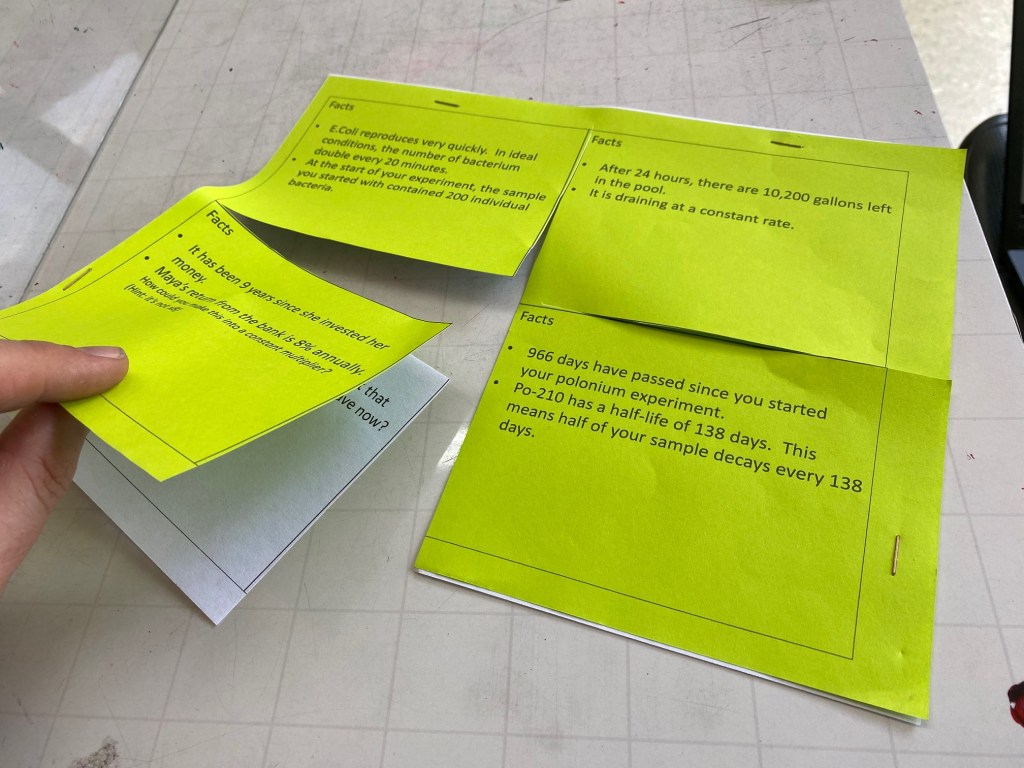
I also try to give groups problems in a random order so that they are working together against each problem, and not trying to race other groups in the class. When this routine works, your main job is to monitor, give feedback and check their thinking against an answer key. Here’s some stuff I made. I hope it’s helpful!
Resources:
Editable powerpoint slides:
PDF versions of:

 Cantankchris Math